The Table
Building the Cheese Board
The board that gives your oil its stage — ratios, order, and restraint.
Home › The Pantry
The most useful luxury in the pantry, and the most mislabeled. What extra virgin means, how oil dies, and how to pick the bottle worth wrapping.
No pantry item carries more mystification than olive oil, and none deserves it less. It is fruit juice — pressed olives, nothing added — with a shelf life, a harvest, and a personality that fades exactly the way fruit does. Understand five things and you will choose better bottles than most restaurants: what the words mean, what kills oil, what a label must show, what quality tastes like, and why small is beautiful when it becomes a gift.
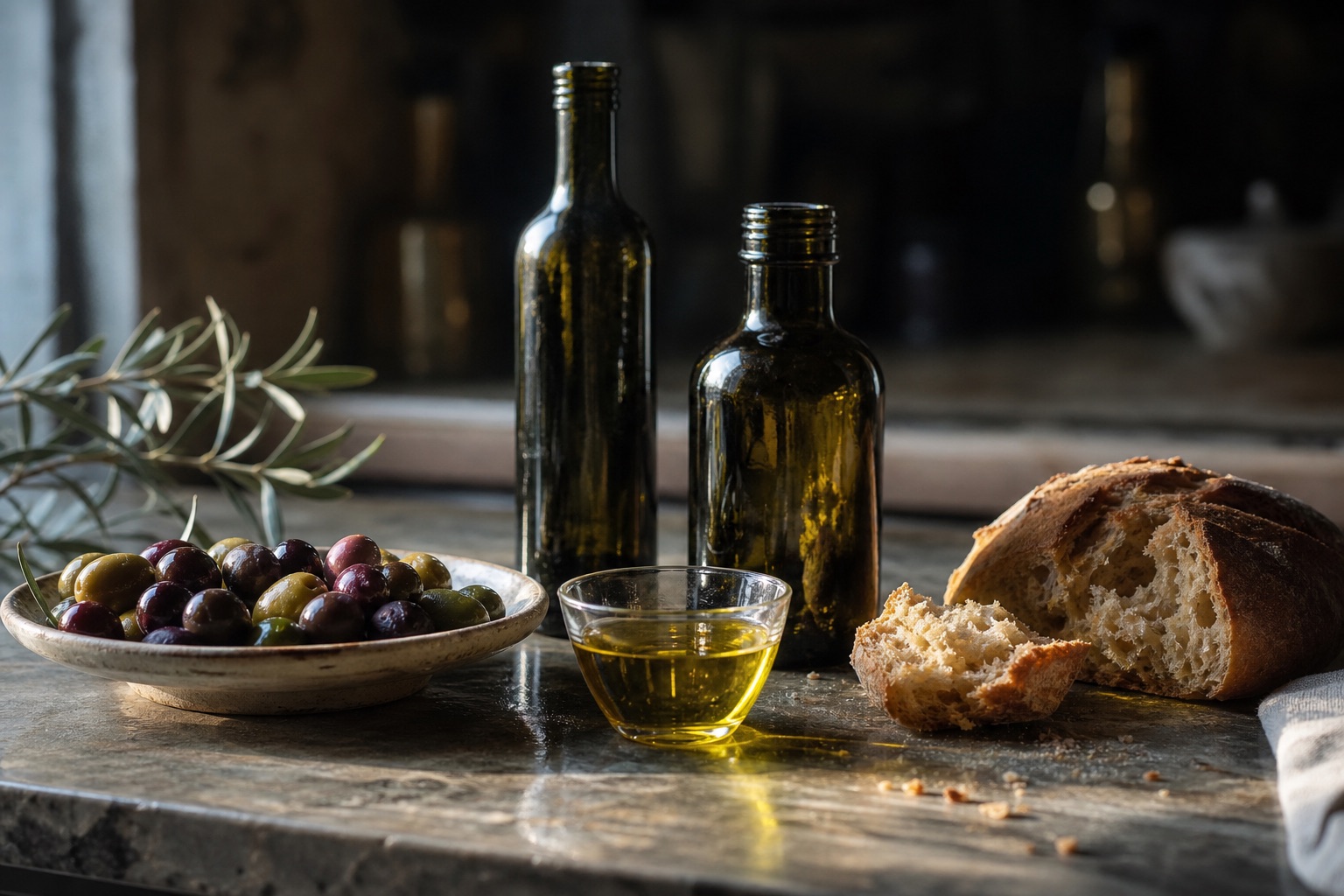
Extra virgin is a chemical and sensory grade, not a marketing tier. The oil must come from olives pressed mechanically (no solvents, no heat beyond ambient), with free acidity below 0.8 percent and no sensory defects as judged by a trained panel. That last clause is where most supermarket oil quietly fails — "fusty" and "winey" defects are common and, to a practiced palate, obvious. The grade says nothing about age. An oil can be certified extra virgin and two years stale; the harvest date is what protects you.
Olive oil dies of light, heat, and air, in that order of violence. Light is why serious oil comes in dark glass or tins and why the pretty clear bottle on the windowsill is a crime scene. Heat is why the stove-side shelf halves an oil's life — keep it in the pantry, cool and dark. Air is why a half-empty bottle ages faster than a full one, and why the 3-liter tin is a restaurant's purchase, not a household's. Fresh oil keeps its character roughly twelve to eighteen months from harvest, a few months longer sealed. After that it is not dangerous — just departed.
Four honest markers, missing none:
The American industry — California especially — has grown serious, and its labels are often the most transparent on the shelf; our terroir compass maps where it fits among the regional gifts.
Quality olive oil has a signature: a peppery bite at the back of the throat, sometimes a cough. That bite is oleocanthal and its polyphenol cousins — the compounds behind the oil's famous health associations and its freshness. Dead oil is flat and waxy; live oil is grassy, artichoke-y, faintly bitter, and peppery. To taste at home: warm a small cup in your hands, cover, swirl, uncover, and inhale; then sip and aspirate. If a "premium" oil slides down without any catch, you have paid for packaging.
Oil is the everyday luxury — the gift that turns an ordinary Tuesday slightly ceremonial, which is the best thing a food gift can do. But gift it small. A 250–500 ml bottle of vivid, recent-harvest oil will be finished at its peak; a liter will oxidize on the counter and teach the recipient to hoard rather than use. One excellent small bottle beats a set of three mediocre ones, and pairs beautifully — build the rest of the basket with our four-layer method: breadsticks or a pasta, a preserve, a chocolate, a cloth. For the housewarming register it anchors the pantry starter; for the thank-you register it is one of the five foods that never miss, per the gratitude guide.
The Table
The board that gives your oil its stage — ratios, order, and restraint.
By Occasion
The everyday bottle anchors the starter pantry for a new home.
The Pantry
The other everyday luxury — varietals and the jar that always lands.